
You can receive an attractive offer, impressive benefits, and a great-looking job description—and still discover after joining that the day-to-day workplace experience is completely different from what you expected.
Is management supportive?
Can employees speak honestly without fear?
Are workloads reasonable?
Is there a genuine opportunity to grow?
Does the company recognize good work?
These questions are difficult to answer from a careers page alone.
That is why workplace culture should be one of the most important things you investigate before applying for or accepting a job.
In this guide, we'll explain how to evaluate a company's workplace culture, what warning signs to look for, and why verified employee feedback can give job seekers a more useful picture of what it is actually like to work somewhere.
What Is Workplace Culture?
Workplace culture is the collection of behaviors, expectations, values, management practices, and everyday experiences that shape what it feels like to work at an organization.
It is not simply the company's mission statement or the values written on its website.
Culture can be seen in everyday situations:
How managers treat employees
How leaders communicate decisions
Whether employees feel comfortable speaking up
How workloads are managed
Whether good work is recognized
How disagreements are handled
Whether employees have opportunities to grow
How fairly people are treated
Whether employees have autonomy
How HR responds to problems
A company can have free lunches, attractive offices, and team events while still having serious workplace culture problems.
The important question is not "What does the company say about its culture?"
It is:
"What do employees actually experience?"
Why You Should Research Workplace Culture Before Applying
Most candidates research a company before an interview.
They look at its website, products, leadership team, recent news, salary information, and job descriptions.
But workplace culture often receives less attention.
That can be a mistake.
A job can affect your daily routine, career development, income, relationships, stress levels, and long-term professional growth. Understanding the environment before joining can help you make a more informed decision.
For example, two companies may offer similar salaries for the same position.
One may provide supportive management, reasonable workloads, career development, and psychological safety.
The other may have constant micromanagement, poor communication, limited growth opportunities, and an unhealthy work environment.
The job title and salary might look almost identical.
The actual employee experience may not be.
10 Signs of a Healthy Workplace Culture
There is no single definition of a perfect workplace. Different employees value different things.
However, there are several areas that can help you evaluate an organization's culture.
1. Employees Can Speak Up
A healthy workplace should allow employees to raise concerns, disagree with ideas, ask questions, and admit mistakes without automatically fearing retaliation.
This is closely connected to psychological safety.
When people feel safe speaking honestly, problems can be identified before they become larger organizational issues.
When employees are afraid to speak, problems can remain hidden.
2. Managers Support Their Teams
Your direct manager can have a major impact on your everyday work experience.
Look for evidence of:
Clear communication
Fair treatment
Constructive feedback
Reasonable expectations
Coaching and development
Respect for employees' time
A company's reputation at the leadership level does not necessarily tell you what your immediate manager will be like.
That is why management should be evaluated separately from senior leadership.
3. Workloads Are Sustainable
A demanding job is not automatically a bad job.
Some industries naturally involve long hours or periods of intense work.
The bigger question is whether the workload is sustainable and whether personal boundaries are respected.
Consider asking current or former employees about:
Typical working hours
Weekend expectations
After-hours communication
Vacation practices
Flexibility
Staffing levels
These details can reveal much more than a generic statement about "work-life balance."
4. Employees Have Opportunities to Grow
A healthy workplace should provide some path for employees to develop their skills and careers.
That might include:
Training
Mentorship
New responsibilities
Internal mobility
Promotions
Learning budgets
Exposure to new projects
If employees repeatedly describe roles as dead ends, that may be worth investigating before accepting an offer.
5. Good Work Is Recognized
Recognition does not always mean bonuses or promotions.
It can also mean managers giving credit, acknowledging contributions, and communicating appreciation.
If employees consistently feel invisible despite strong performance, that can affect engagement and retention.
6. Employees Have Reasonable Autonomy
Micromanagement can make even an otherwise attractive job frustrating.
Pay attention to how much trust employees receive.
Are people trusted to complete their work?
Can they make reasonable decisions independently?
Are managers focused on outcomes or constantly monitoring every small action?
Autonomy is particularly important when evaluating knowledge-based and creative roles.
7. Employees Are Treated Fairly
Look beyond official diversity statements.
Try to understand how employees actually experience:
Promotions
Compensation
Recognition
Opportunities
Workplace policies
Managerial decisions
A company's published values are useful, but employee experiences provide another perspective.
8. HR Is Accessible When Problems Occur
HR plays an important role when employees have questions, concerns, or workplace problems.
Look for evidence that HR handles issues consistently and fairly.
You can also ask employees whether they feel comfortable approaching HR when something goes wrong.
9. Toxic Behavior Is Not Normalized
Every workplace has disagreements.
That is different from an environment where bullying, harassment, politics, gossip, intimidation, or retaliation become normal parts of the employee experience.
Repeated reports of these behaviors deserve attention.
10. Employees Actually Recommend the Workplace
One useful question is simple:
Would employees recommend this company as a place to work?
The answer should not be considered in isolation, but patterns across multiple employee experiences can provide useful context.
Don't Judge a Company Based on One Employee Review
This is important.
A single review rarely tells you the entire story.
An employee could have had an unusually good or unusually bad experience. Their department, manager, location, seniority, or time at the company may also affect their perspective.
Instead of asking:
"Is this one review positive or negative?"
Ask:
"What patterns appear across multiple verified employee experiences?"
This is one reason aggregated workplace data can be more useful than relying on isolated anecdotes.
Look at Multiple Dimensions of Workplace Culture
Another mistake is evaluating a company based on only one factor.
For example, a company might offer excellent salaries but have poor management.
Another might have strong leadership but limited career development.
Another might provide flexibility but have problems with recognition or workload.
Workplace culture is multidimensional.
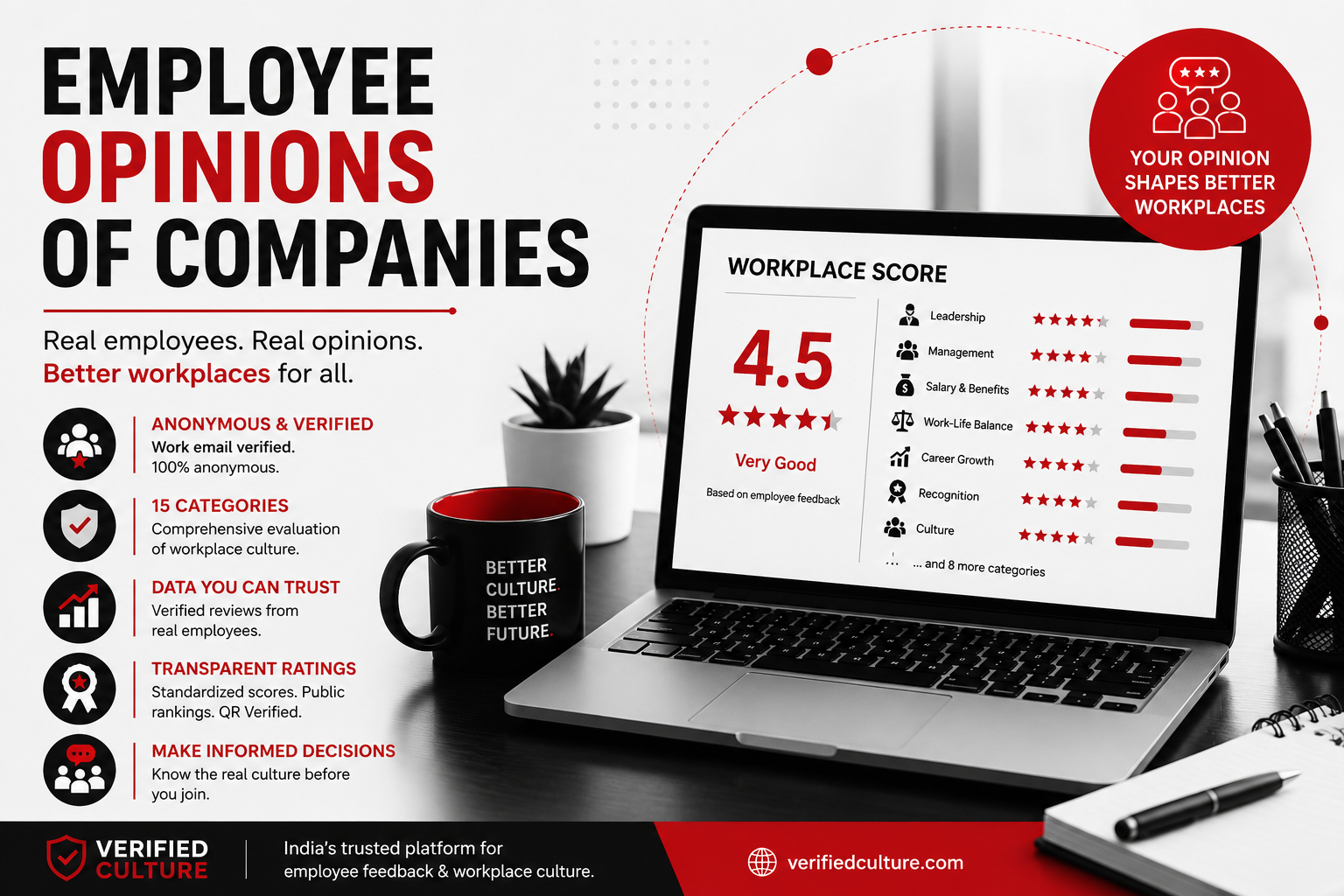
Verified Culture evaluates workplaces across 15 categories, including leadership, management, salary and benefits, work-life balance, career growth, recognition, diversity, inclusion, culture, toxic behavior, micromanagement, HR support, infrastructure, learning, and psychological safety.
Looking at these dimensions separately can help candidates understand where a workplace performs well and where potential concerns may exist.
Why Verified Employee Feedback Matters
Companies naturally want to present themselves positively.
Careers pages often highlight:
Company values
Benefits
Office facilities
Team events
Flexible working
Career opportunities
Employer awards
These things can be useful.
But they do not necessarily tell you what employees experience every day.
Verified Culture takes a different approach: employees submit anonymous workplace ratings that are verified through work-email verification, while the published results are aggregated rather than attributed to individual employees.
The platform evaluates 15 areas of workplace experience and publishes its methodology so people can understand how scores are calculated.
That creates an additional source of information for someone researching a potential employer.
What Should You Check Before Applying?
Before submitting your CV, consider researching these areas:
Company-level information
Overall workplace score
Employee feedback
Culture categories
Leadership
Management
Work-life balance
Career growth
Salary and benefits
Psychological safety
Toxic behavior
Micromanagement
Job-specific information
Responsibilities
Expected working hours
Location or remote policy
Reporting manager
Career progression
Team structure
Compensation
Performance expectations
External signals
You can also compare information from:
Employee reviews
Professional networks
Company announcements
Industry discussions
Job descriptions
Interviews with current or former employees
No single source should automatically be treated as the complete truth.
The goal is to identify consistent patterns.
Questions to Ask During an Interview
Interviews are not only an opportunity for employers to evaluate candidates.
They are also an opportunity for candidates to evaluate employers.
Consider asking:
"How does the team handle disagreement?"
This can reveal how open the organization is to different opinions.
"How is employee performance evaluated?"
This can help you understand expectations and management practices.
"What does career progression typically look like for someone in this position?"
This can reveal whether growth is structured or mostly informal.
"How does the team handle periods of high workload?"
This can tell you more about work-life balance than a benefits page.
"Why did the previous person leave this role?"
The answer may provide useful context.
"What is one thing the company is currently trying to improve?"
A thoughtful answer can reveal whether leadership acknowledges areas that need work.
Watch Out for Culture Red Flags
Some warning signs are subtle.
Be cautious when you repeatedly encounter statements such as:
"We're like a family here."
"Everyone works hard, so flexibility isn't really necessary."
"You need to be available whenever something comes up."
"We don't really believe in job descriptions."
"People who succeed here are extremely committed."
"We don't have much hierarchy, so everyone does everything."
None of these statements automatically means a company has a poor culture.
Context matters.
The important thing is to understand what the statement means in practice.
For example, "everyone is committed" could describe a highly motivated team—or it could mean employees are expected to work excessive hours.
Ask follow-up questions.
Culture Is More Than Perks
Ping-pong tables, free snacks, office parties, and attractive offices can be nice.
But they are not substitutes for:
Fair management
Reasonable workloads
Career development
Respect
Psychological safety
Fair compensation
Recognition
Trust
When evaluating a workplace, focus on the things that affect your experience after the onboarding period ends.
The best question isn't:
"Does this company look fun?"
It is:
"What is it actually like to work here?"
How to Use Workplace Scores Responsibly
Workplace scores can provide useful information, but they should be interpreted carefully.
A score is not a complete description of every employee's experience.
Look at:
The number of verified responses
The categories behind the overall score
The age of the feedback
Whether different reviews show consistent patterns
Your own priorities for a job
Verified Culture's methodology uses time-decay weighting so older employee experiences have less influence than more recent ones, and certificates are based on defined verification and scoring rules.
The result is intended to provide a structured signal—not replace your own research.
A Simple Checklist Before You Apply
Before applying for your next job, ask yourself:
Have I researched the company's workplace culture?
Have I looked beyond the company's own careers page?
Have I checked employee feedback?
Do I understand the management environment?
Have I investigated work-life balance?
Do employees have opportunities to grow?
Can employees speak openly?
Are there repeated reports of toxic behavior?
Does the compensation match the responsibilities?
Have I asked culture-related questions during the interview?
Does the workplace fit my priorities?
If you cannot answer several of these questions, you may not have enough information yet to make an informed decision.
Final Thoughts
A job offer tells you what a company wants you to know.
Employee experiences can tell you something different: what the workplace is actually like after you join.
That is why researching workplace culture should become a normal part of the job search.
Look beyond salary.
Look beyond perks.
Look beyond the careers page.
Examine leadership, management, workload, career growth, recognition, psychological safety, workplace behavior, and the experiences of the people who already work there.
Before you apply, find out what the job is really like.
Verified Culture helps job seekers explore workplace culture through anonymous, work-email-verified employee feedback across 15 workplace categories. You can use the information to research an organization before deciding whether to apply.
Explore Verified Culture and check a workplace before your next application.
Frequently Asked Questions
What is a good workplace culture?
A good workplace culture generally involves respectful management, sustainable workloads, opportunities for growth, fair treatment, recognition, psychological safety, and an environment where employees can communicate openly.
How can I find out what a company is really like before joining?
Research employee feedback, review the company's workplace information, ask specific culture questions during interviews, and compare multiple sources rather than relying on the employer's own marketing.
What are the biggest signs of a toxic workplace?
Repeated reports of bullying, harassment, retaliation, excessive micromanagement, unreasonable workloads, poor communication, or fear of speaking up can be warning signs that deserve further investigation.
Should I trust employee reviews?
Employee reviews can provide valuable information, but individual reviews represent individual experiences. Look for patterns across multiple reviews and consider factors such as recency, sample size, and the specific workplace categories being discussed.
What should I look for in a company besides salary?
Consider management quality, work-life balance, career growth, recognition, psychological safety, workplace culture, autonomy, HR support, learning opportunities, and how employees are treated.
Why is psychological safety important at work?
Psychological safety relates to whether employees feel able to speak up, disagree, ask questions, or acknowledge mistakes without fear. It can be an important part of understanding the everyday workplace environment.
How does Verified Culture evaluate workplaces?
Verified Culture collects anonymous, work-email-verified employee feedback across 15 workplace categories. Its methodology publicly explains how ratings are aggregated and how verification and fraud controls are applied.
Can employers change their Verified Culture score by paying?
Verified Culture states that employers cannot pay to alter their score or remove a legitimate verdict. Scores are calculated from survey data under the published methodology.
Suggested internal links: Workplace Methodology · Good Place to Work · FAQ · Hiring · Rate Your Workplace
Suggested featured image: A job seeker researching a company on a laptop, with a workplace culture score/dashboard visible on screen; clean professional editorial style.
Good Place to Work
Organizations that clear the 70% participation threshold and score highly across all 15 culture categories earn verified recognition.
Explore certified workplacesWorst Place to Work
When employees consistently report toxic patterns, the verdict is published — and the company can request a re-survey once it has fixed the issues.
See the red-flag listYour experience decides the verdict
The survey takes about 5 minutes, is fully anonymous, and email verification means one honest response per employee.
Keep reading

Questions about this article?
Send us a note — press, partnerships, or anything you'd like us to cover next.