Every workplace has two stories: the one the company tells, and the one its employees live. The truth behind the workplace sits in the gap between them — and the only people who can tell it honestly are the employees themselves.
A job description may promise growth. A recruiter may describe the organization as having a “great culture.” A careers page may highlight attractive benefits, flexible working, team events, and professional development. But none of that tells you what Monday morning actually feels like inside the company.
So the question that matters more than all of these is:
What do the employees actually think about the company?
This is where employee opinions of companies become extremely valuable.
Employees experience an organization from the inside. They know how managers communicate, whether leadership listens, whether workloads are reasonable, whether salaries feel fair, whether employees can speak openly, and whether the company's stated values match everyday reality.
That is why employee reviews and workplace feedback have become an increasingly important part of modern job research.
Instead of relying only on what a company says about itself, employees and job seekers can look at what the people working there actually experience.
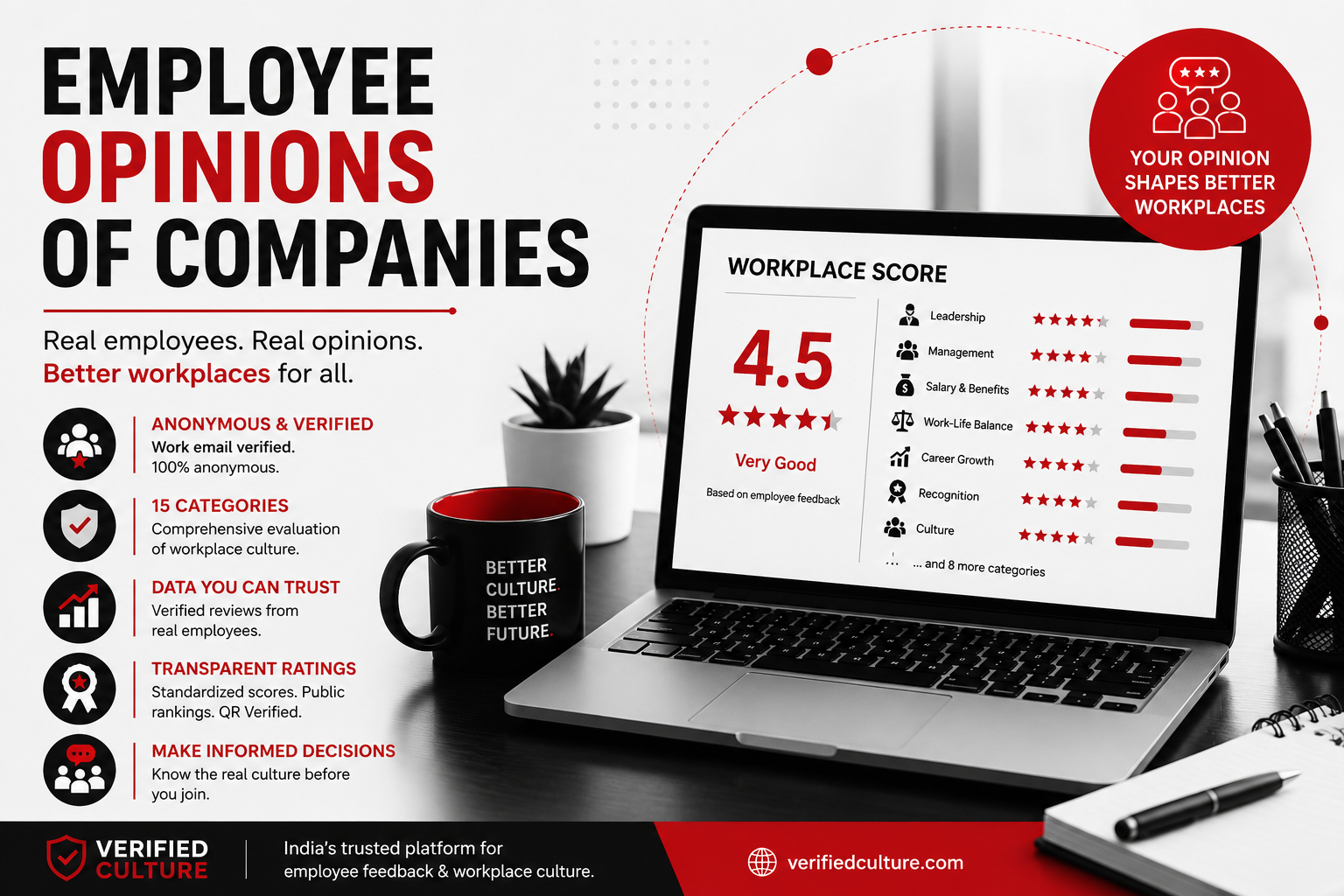
Platforms such as Verified Culture are built around this idea: giving employees a way to anonymously rate workplaces while helping candidates make more informed career decisions. Verified Culture uses work-email verification and evaluates workplaces across 15 categories, including leadership, management, salary and benefits, work-life balance, career growth, recognition, diversity, inclusion, culture, toxic behaviour, micromanagement, HR support, infrastructure, learning, and psychological safety.
What Are Employee Opinions of Companies?
Employee opinions of companies are the experiences, perceptions, ratings, and feedback employees have about the organizations where they work or have worked.
These opinions can cover almost every aspect of the employee experience, including:
Company culture
Leadership
Management
Salary and benefits
Work-life balance
Career growth
Recognition
Diversity
Inclusion
Psychological safety
Workplace toxicity
Micromanagement
HR support
Learning opportunities
Workplace infrastructure
Employee opinions can be expressed through surveys, reviews, ratings, interviews, feedback platforms, internal engagement surveys, or anonymous workplace-review platforms.
The important difference is that employee opinions provide a perspective that company marketing generally cannot provide.
A company might say:
“Employees are our greatest asset.”
Employee feedback can help answer:
Do employees actually feel that way?
A company might say:
“We have excellent leadership.”
Employee reviews can reveal whether employees believe leadership is transparent, supportive, and accountable.
A company might advertise:
“We provide excellent career opportunities.”
Employee opinions can show whether employees actually receive promotions, training, mentorship, and opportunities to grow.
This gap between what a company says and what employees experience is one of the most important reasons employee reviews matter.
Why Are Employee Opinions of Companies Important?
1. Employees See the Reality Behind the Brand
Every organization has an employer brand.
Companies invest heavily in:
Careers websites
Recruitment campaigns
Social media
Employer branding
Recruitment advertisements
Corporate videos
Employee testimonials
These materials can be useful, but they represent the organization's public image.
Employee opinions provide another perspective.
They can tell you what happens after you accept the offer.
For example, a company may advertise flexible work arrangements. Employee feedback can reveal whether managers actually respect those arrangements.
A company may advertise professional development. Employees can tell you whether training and promotions genuinely happen.
A company may promote an open-door culture. Employees can reveal whether people feel safe disagreeing with management.
This makes employee feedback one of the most useful sources of workplace intelligence.
2. Employee Reviews Help Job Seekers Make Better Decisions
Finding a job is not simply about finding the highest salary.
A job can look excellent on paper and still become a poor career choice if the working environment is unhealthy.
Before accepting a job, candidates should consider questions such as:
Is management supportive?
Is the workload sustainable?
Are employees treated fairly?
Is compensation competitive?
Are promotions based on performance?
Does HR respond to employee concerns?
Can employees disagree with leadership?
Is workplace communication transparent?
Are employees recognized for good work?
Are there genuine opportunities to learn?
Does the organization respect personal boundaries?
Employee opinions of companies can help candidates investigate these questions before joining.
This is especially valuable because changing jobs has a real cost.
A person may spend months applying, interviewing, negotiating, resigning, relocating, and onboarding.
Understanding the workplace before making that decision can save significant time and stress.
3. Company Culture Is More Than Free Food and Office Events
One of the biggest misconceptions about workplace culture is that culture means office parties, team lunches, games, or free snacks.
Those things can be enjoyable, but they are not the foundation of company culture.
Real workplace culture is reflected in everyday behavior.
For example:
How does a manager respond when an employee makes a mistake?
Can an employee disagree with a senior leader?
Does the organization reward results or favoritism?
Are workloads sustainable?
Are employees respected when they take leave?
Does HR genuinely investigate complaints?
Are promotions transparent?
These experiences shape how employees perceive their workplace.
That is why a structured employee-opinion platform can be more useful than a simple “Do you like your company?” question.
4. Employee Feedback Can Reveal Management Problems
People often leave managers rather than companies.
A strong manager can make a demanding job enjoyable.
A poor manager can make a good job unbearable.
Employee opinions can reveal management patterns such as:
Micromanagement
Poor communication
Lack of recognition
Unclear expectations
Favoritism
Excessive workload
Lack of coaching
Poor conflict resolution
Unfair treatment
This is why management should be evaluated separately from overall company culture.
A company can have a strong brand while individual teams experience very different management environments.
5. Salary Is Important — But It Is Not Everything
Compensation remains one of the most important factors employees consider.
However, employees generally evaluate their workplace through a combination of financial and non-financial factors.
For example, an employee may accept a slightly lower salary if the organization provides:
Better work-life balance
Strong career growth
Better management
Flexible working
Learning opportunities
Psychological safety
Recognition
Greater autonomy
On the other hand, a high salary may not compensate for a consistently toxic workplace.
That is why salary and benefits should be considered alongside the broader employee experience.
The 15 Areas Employees Should Evaluate
One of the useful aspects of a structured employee-review system is that it prevents workplace culture from being reduced to a single vague rating.
Verified Culture evaluates workplaces across 15 categories.
1. Leadership
Employees evaluate whether senior leaders are honest, visible, transparent, and clear about organizational direction.
Strong leadership creates confidence.
Poor leadership creates uncertainty.
2. Management
This focuses on the quality of direct managers.
Employees can consider whether managers provide:
Support
Coaching
Fair treatment
Clear expectations
Useful feedback
Professional respect
3. Salary & Benefits
Employees evaluate whether compensation and benefits feel appropriate for their role and the market.
This can include salary, bonuses, benefits, allowances, insurance, and other forms of compensation.
4. Work-Life Balance
A healthy workplace should allow employees to perform well without making unsustainable workloads normal.
Employees can evaluate:
Working hours
Flexibility
Leave culture
Weekend expectations
After-hours communication
Personal boundaries
5. Career Growth
Employees want to know whether the company can help them build their careers.
Important questions include:
Are promotions available?
Is career progression transparent?
Is internal mobility possible?
Do employees receive mentorship?
Are learning opportunities available?
6. Recognition
Employees want their work to be noticed.
Recognition does not always mean financial rewards.
It can also mean:
Appreciation
Credit
Career opportunities
Public recognition
Constructive feedback
A workplace where employees consistently feel invisible can quickly become demotivating.
7. Diversity
Diversity is about representation and fair treatment across different backgrounds.
Employees can assess whether the organization creates equal opportunities across levels and teams.
8. Inclusion
Diversity and inclusion are related but different.
An organization can hire a diverse workforce without ensuring that everyone feels heard.
Inclusion asks:
Do employees actually have a voice?
9. Culture
Culture represents the everyday experience of working at the organization.
It includes the behaviors, attitudes, communication patterns, expectations, and norms employees encounter.
10. Toxic Behaviour
Employees should be able to work without bullying, harassment, unnecessary politics, gossip, intimidation, or destructive behavior.
A structured review system can help identify recurring concerns around workplace toxicity.
11. Micromanagement
Employees generally perform better when they have an appropriate level of trust and autonomy.
Excessive monitoring can reduce motivation and make employees feel that they are not trusted.
12. HR Support
Human Resources plays an important role in employee experience.
Employees can evaluate whether HR responds to concerns fairly, professionally, and promptly.
13. Infrastructure
Employees need the right tools and resources to perform their jobs.
This can include:
Technology
Software
Equipment
Workspace
Internet connectivity
Operational resources
14. Learning
Career development requires continuous learning.
Employees can evaluate access to:
Training
Mentorship
Courses
Skill development
Professional certifications
Learning budgets
15. Psychological Safety
Psychological safety is one of the most important dimensions of workplace culture.
Employees should feel able to:
Ask questions
Admit mistakes
Raise concerns
Disagree respectfully
Suggest improvements
Speak to leadership
without fearing retaliation or unnecessary career consequences.
Anonymous Employee Opinions: Why Anonymity Matters
Employees may hesitate to provide honest feedback if they believe their identity could be revealed.
This is especially true when feedback concerns:
Senior leadership
Managers
Workplace harassment
Salary
Toxic behavior
HR problems
Psychological safety
Anonymity can therefore encourage more honest feedback.
Verified Culture states that employee reviews are anonymous and that work-email verification is used to confirm that respondents actually work or worked at the organization. The platform says individual identities and individual responses are not published to employers.
This creates an important balance:
Verified identity does not have to mean public identity.
A platform can verify that someone belongs to an organization while keeping the person's identity private.
Why Verification Matters in Employee Reviews
Anonymous reviews are useful, but anonymity can also create concerns about authenticity.
For example:
Was the reviewer actually an employee?
Is someone submitting multiple reviews?
Are reviews coordinated?
Is someone intentionally trying to damage a competitor?
This is why verification and fraud controls matter.
Verified Culture uses work-email verification and describes additional controls for duplicate and suspicious submissions. Its methodology also uses standardized scoring and sample requirements before workplace verdicts are issued.
For candidates, this creates a stronger foundation than relying on completely unverified online comments.
How to Read Employee Reviews Correctly
One negative review should not automatically make you reject a company.
Likewise, one positive review should not convince you that a company is perfect.
Instead, look for patterns.
Look for repeated themes
If multiple employees independently mention:
Poor management
Excessive workload
Low pay
Strong career growth
Excellent leadership
Flexible working
those patterns are more informative than a single comment.
Look at category scores
A company may have a good overall rating but a weak score in one important category.
For example:
Overall: 78%
But:
Leadership: 60%
Work-Life Balance: 55%
Career Growth: 88%
This tells a much more useful story than a single star rating.
Consider the employee's context
Different departments can have different experiences.
A software engineer may have a different experience from someone in sales.
A junior employee may have a different experience from a senior manager.
Therefore, employee opinions should be treated as evidence, not as an absolute prediction of your personal experience.
Employee Opinions vs. Employer Marketing
There are two sides to the employer-brand conversation.
Employer marketing says:
“We have an amazing culture.”
Employee feedback asks:
“Do employees actually experience that culture?”
Employer marketing says:
“We support career growth.”
Employee feedback asks:
“Are employees actually promoted and developed?”
Employer marketing says:
“We value work-life balance.”
Employee feedback asks:
“Are employees expected to work after hours?”
This does not mean employer branding is always dishonest.
It means candidates need independent evidence.
The strongest employer brands are not afraid of employee feedback.
They use it as evidence that their claims match reality.
How Companies Can Use Employee Opinions to Improve
Employee reviews are not only useful for job seekers.
They can also be valuable for employers.
A company receiving negative feedback has an opportunity to understand what is going wrong.
For example, suppose employee feedback identifies three recurring problems:
Poor communication from leadership
Excessive workload
Limited career growth
The organization now has specific areas to address.
Instead of asking:
“Why is employee morale low?”
leadership can ask:
“What can we change about workload, leadership communication, and career progression?”
This transforms employee opinions from criticism into actionable organizational intelligence.
Employee Feedback Should Lead to Action
Collecting employee feedback is only the first step.
The real value comes from what happens next.
A strong feedback cycle looks like this:
Listen → Analyze → Act → Measure → Improve
Step 1: Listen
Give employees a safe way to express their experience.
Step 2: Analyze
Identify recurring patterns rather than reacting to individual comments.
Step 3: Act
Address the categories creating the biggest problems.
Step 4: Measure
Collect feedback again after changes have been implemented.
Step 5: Improve
Continue the process instead of treating employee feedback as a one-time project.
This creates a culture of continuous improvement.
Why Public Workplace Scores Can Increase Accountability
Traditional employee surveys are often private.
Employees provide feedback.
HR receives the results.
Leadership discusses them.
Then the process may disappear.
Public employee feedback creates a different dynamic.
A public workplace score can encourage organizations to take employee sentiment seriously because candidates, employees, and other stakeholders can see the result.
Verified Culture's certification system is designed around public, QR-verifiable workplace certificates and standardized employee feedback. Its current certification information states that a Good Place to Work certificate requires a score of at least 70%, with higher tiers for stronger scores, and certificates are intended to be re-verified periodically.
This creates a simple principle:
Don't just say your workplace is great. Let your employees prove it.
What Is Verified Culture?
Verified Culture is an employee-first workplace feedback and certification platform designed to make company culture more transparent.
Employees can anonymously rate workplaces, while organizations can use aggregated feedback to understand how their workforce experiences the company.
The platform evaluates 15 workplace categories and provides a standardized scorecard rather than relying only on free-form reviews.
The platform's certification system is designed around employee-verified data, public certificates, certificate numbers, and QR verification.
For job seekers, this creates another tool for researching a potential employer.
For employees, it creates a way to share workplace experiences.
For employers, it creates an opportunity to demonstrate that their culture is supported by employee feedback.
How Employees Can Rate Their Workplace on Verified Culture
The process is designed to be straightforward.
Step 1: Find Your Workplace
Search for your organization or add it to the platform.
Step 2: Complete the Employee Survey
Rate the workplace across the relevant culture categories.
Step 3: Submit Your Feedback
The platform uses verification mechanisms while keeping individual employee responses anonymous.
Step 4: View the Result
Aggregated feedback contributes to the organization's workplace score and public profile.
Verified Culture describes the employee process as anonymous, work-email verified, and designed to take only a few minutes.
Rate your workplace on Verified Culture
How Job Seekers Can Use Employee Opinions Before Accepting a Job
If you are considering a new job, don't stop your research after reading the job description.
Use a simple checklist.
Before applying
Research:
Company reputation
Industry
Leadership
Employee reviews
Company culture
Career growth
Before interviewing
Look for:
Management feedback
Work-life balance
Salary sentiment
Employee development
Workplace expectations
Before accepting the offer
Ask:
What do employees say about the organization?
Are there recurring complaints?
Are positive reviews consistent?
Which categories score highest?
Which categories need improvement?
Does the company respond to employee concerns?
This process can help you make a more informed decision.
Questions to Ask During a Job Interview
Employee reviews can tell you what existing employees think.
Interviews allow you to test those findings.
For example, if employee feedback suggests limited career growth, ask:
“How does career progression typically work for someone in this position?”
If work-life balance appears to be a concern, ask:
“What does a typical working week look like for this role?”
If management is a recurring concern, ask:
“How would you describe the management style of the team?”
If learning is important, ask:
“What learning and development opportunities are available to employees?”
Good questions help you determine whether the employee feedback matches what you hear during the interview.
What Makes a Good Employee Review?
A useful employee review should be:
Honest
Describe your real experience.
Specific
Instead of saying:
“Management is bad.”
Explain what happened.
Balanced
Mention both strengths and weaknesses when appropriate.
Professional
Focus on workplace experience rather than personal attacks.
Useful
Provide information that could help future employees understand the organization.
The goal of employee reviews should not be to attack companies.
The goal should be to increase workplace transparency.
Employee Opinions Are Not the Same as Gossip
There is an important distinction between structured employee feedback and workplace gossip.
Gossip is usually:
Unverified
Personal
Emotional
Context-free
Structured employee feedback can be:
Anonymous
Verified
Categorized
Aggregated
Comparable
Actionable
This distinction is important because organizations need useful employee sentiment, not simply more online noise.
The Future of Employer Reputation
Employer reputation is becoming increasingly transparent.
Employees can share workplace experiences online.
Candidates can research companies before applying.
Organizations can compare employee sentiment.
Recruiters can no longer rely exclusively on carefully written employer-branding messages.
The future is moving toward a model where organizations increasingly have to prove their workplace culture rather than simply describe it.
That is where employee opinions of companies become powerful.
A company's reputation is no longer created only by its marketing department.
It is created by the people who work there.
Employee Opinions of Companies: A New Standard for Workplace Transparency
The workplace has changed.
Employees want more than a salary.
They want:
Respect
Fairness
Growth
Recognition
Psychological safety
Good leadership
Sustainable workloads
Meaningful development
A healthy culture
At the same time, job seekers want reliable information before committing their careers to an organization.
That is why employee opinions of companies matter.
Employee reviews can help candidates see beyond employer marketing.
Structured employee feedback can help companies identify problems.
Verified ratings can create greater accountability.
And transparent workplace scores can encourage organizations to continuously improve.
The most important question is no longer simply:
“Is this a good company?”
The better question is:
“What do the people who work there actually say?”
Final Thoughts
Every company has a story it tells about itself.
But every company also has a story told by its employees.
The difference between those two stories can reveal a great deal about workplace culture.
If you are a job seeker, employee opinions can help you make a smarter career decision.
If you are an employee, your feedback can help create greater workplace transparency.
If you are an employer, listening to employee opinions can help you identify problems before they become expensive retention and reputation issues.
Platforms like Verified Culture are helping move workplace reputation toward a more employee-driven model — one where organizations are evaluated based on the experiences of the people who actually work there.
Because workplace culture shouldn't just be claimed. It should be experienced, measured, and verified.
Explore Verified Culture
Frequently Asked Questions About Employee Opinions of Companies
What are employee opinions of companies?
Employee opinions of companies are the ratings, experiences, perceptions, and feedback employees provide about their workplace. They can cover management, leadership, salary, culture, work-life balance, career growth, psychological safety, and other workplace factors.
Why are employee opinions important?
Employee opinions provide an inside perspective on an organization. They can help job seekers understand workplace culture before accepting a job and help employers identify areas that need improvement.
Where can I find employee reviews of companies?
Employees can find company reviews through workplace-review platforms, employee surveys, professional networks, and dedicated employee-feedback platforms such as Verified Culture.
Are anonymous employee reviews useful?
Yes. Anonymity can make employees more comfortable discussing sensitive workplace topics. However, verification mechanisms are also important to improve the credibility of anonymous feedback.
How should I evaluate employee reviews?
Look for patterns across multiple reviews and categories rather than relying on one comment. Consider leadership, management, compensation, work-life balance, career growth, culture, and psychological safety.
What should I check before joining a company?
Before accepting a job, research employee reviews, workplace culture, management, salary sentiment, career opportunities, work-life balance, employee development, and recurring employee concerns.
What is Verified Culture?
Verified Culture is an employee-focused workplace feedback and certification platform that allows employees to anonymously rate organizations using a structured 15-category workplace scorecard. The platform also provides public workplace rankings and QR-verifiable certification.
Can companies use employee feedback to improve?
Yes. Employee feedback can identify recurring issues with leadership, management, workload, compensation, career development, psychological safety, and other aspects of workplace culture. Companies can use those insights to prioritize improvements and measure progress over time.
Why is psychological safety important at work?
Psychological safety allows employees to raise concerns, ask questions, admit mistakes, and disagree respectfully without fear of retaliation. It is an important part of a healthy workplace environment.
Should I reject a company because of one negative review?
Not necessarily. One review represents one person's experience. Look for recurring patterns, category-level scores, the context of the review, and how the organization responds to feedback before making a decision.
Good Place to Work
Organizations that clear the 70% participation threshold and score highly across all 15 culture categories earn verified recognition.
Explore certified workplacesWorst Place to Work
When employees consistently report toxic patterns, the verdict is published — and the company can request a re-survey once it has fixed the issues.
See the red-flag listYour experience decides the verdict
The survey takes about 5 minutes, is fully anonymous, and email verification means one honest response per employee.
Keep reading



Questions about this article?
Send us a note — press, partnerships, or anything you'd like us to cover next.